
Carpet and Stair Runner Fitting in Dublin: What the Job Actually Involves
Dublin carpet fitting guide: learn pre-installation tips, techniques, and expert questions to ask your fitter for perfect stair installation.
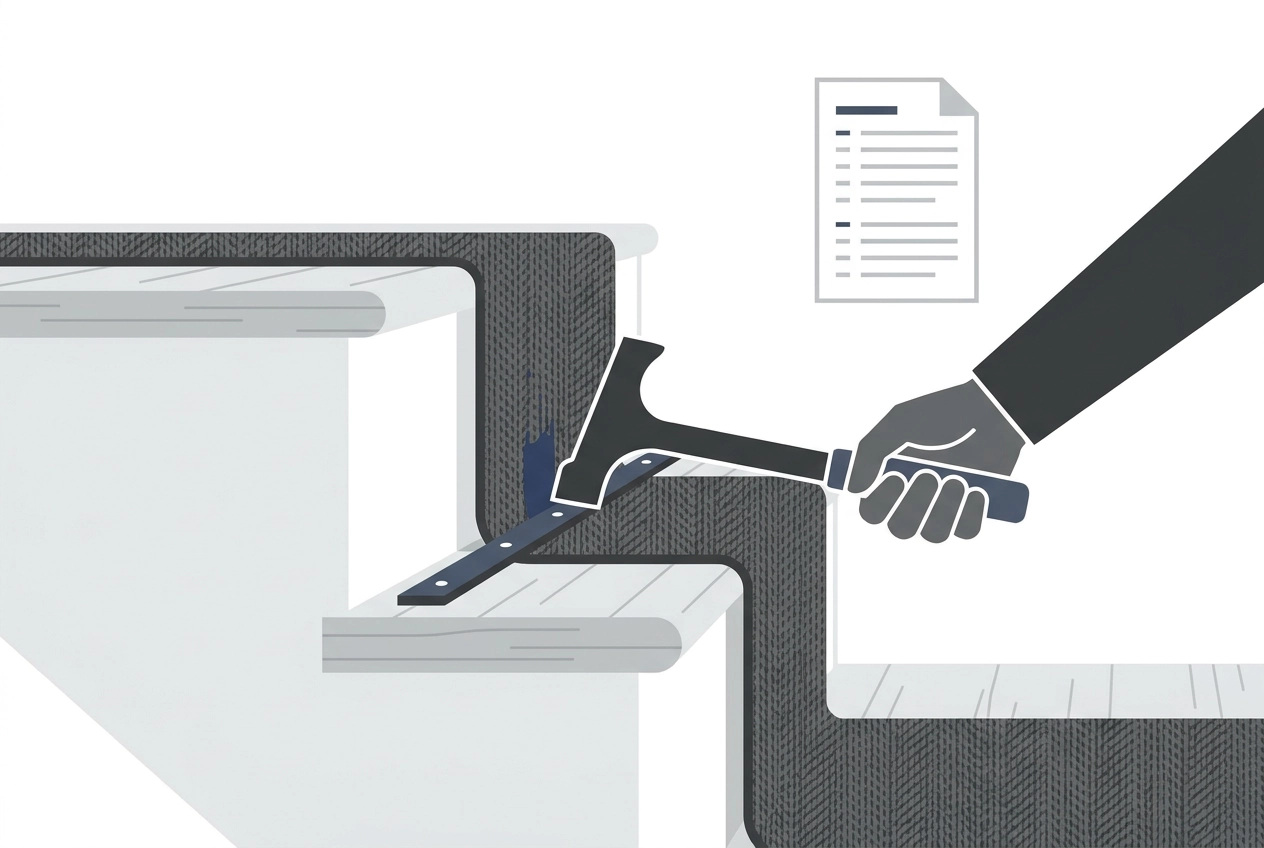
There is a moment every Dublin homeowner recognises: the carpet is laid, the fitter has packed up and left, and something is not quite right. A ripple runs across the living room floor. A stair nosing sits at an awkward angle. The runner has already started to lift at the edge. At that point, there is no quick fix. The only option is to pull the whole job out and start again.
Dublin carpet fitting is, without question, the most technique-dependent flooring installation you will ever commission for your home. Unlike hard floors, where a single tile or plank can be swapped out, carpet and stair runners live or die by the quality of the original installation. Every cut, every stretch, every piece of underlay either supports the finished product or quietly undermines it.
This guide walks you through everything you need to know before, during, and after your fitting day. From what a professional pre-installation consultation covers, to how the cap and band method works on stairs, to the questions worth asking your fitter before work begins, you will finish this post knowing exactly what good looks like.
Why Carpet and Stair Runner Fitting Is Unlike Any Other Flooring Job
Carpet and stair runners sit in a different category from every other flooring product a Dublin homeowner will buy. Lay a laminate plank incorrectly and you lift it and relay it. Cut a carpet wrong, stretch it unevenly, or fit the wrong underlay, and the only remedy is a full relay from scratch. No patching, no reversing course.
That irreversibility matters most on stairs. Improper stretching creates rippling that worsens with every footfall. Badly cut nosings leave raw edges that fray and lift. The wrong underlay density produces compression at the tread edge within months, or a rolling trip hazard as the carpet settles. Professional fitting makes a real difference here in a way it simply does not with hard flooring.
Stair runner fitting demands precision carpentry, fabric knowledge, and spatial problem-solving working together. It is a fundamentally different skill set from fitting carpet in a flat room.
Dublin's housing stock adds further complexity. Many of Dublin's older homes, Victorian and Edwardian terraces in particular, can have non-standard stair widths and uneven timber treads that require adapted technique. No two staircases are identical, and understanding the real difference between professional and DIY fitting becomes especially relevant here.
Knowing the stakes before you book means you ask sharper questions and recognise quality work when you see it.
Before the Fitter Arrives: What a Proper Pre-Installation Consultation Covers
A professional consultation is where good stair fitting is won or lost, long before a single gripper rod is fixed.
A skilled fitter measures every individual tread, riser, and landing separately. In older Dublin homes, treads are rarely uniform; a single total linear measurement misses variations that affect both material quantities and cutting precision. Our Fitting & Measuring process accounts for this from the outset.
Underlay selection happens at this stage too, not as an afterthought. The fitter assesses subfloor condition, expected foot traffic, and stair configuration before recommending the correct density and thickness. On stairs, a high-density underlay in the 8-10 mm range is typically correct; too thin and the carpet compresses prematurely, too thick and it creates a rolling edge at the nosing that becomes a genuine trip hazard as the carpet settles.
Stair configuration is assessed for complexity at the same visit. Straight stairs, 90-degree turns with landings, and curved or winding stairs each demand a different cutting approach and different amounts of material. An experienced fitter will calculate this accurately first time; guesswork at this stage leads to waste or, worse, running short mid-job.
Carpet style suitability is confirmed here as well. Loop pile ranges behave differently on stairs than cut pile options; a knowledgeable fitter will flag any mismatch before material is ordered, not after it has been cut.
At 5th Avenue Floor Store, every fitting is carried out by craftsmen with over 20 years of experience, so the standards agreed at consultation are delivered on fitting day.
What to Ask Your Carpet Fitter Before the Job Starts
Once the consultation is done, the next step is asking the right questions before anyone picks up a Stanley knife.
1. How many years have you been fitting carpet on stairs specifically? General carpet fitting experience does not transfer automatically to stair work. Ask for stair-specific years, not overall trade time, and request examples of similar configurations to yours.
2. What method will you use on my stairs? A competent fitter names the technique immediately: the cap and band method, a waterfall fit, or a combination approach for landings. Vagueness here is a warning sign.
3. What underlay are you recommending and why? The fitter should justify the choice based on your stair type and carpet range. If the answer defaults to whatever is cheapest or most available, push back.
4. How will you handle the nosings? Stair nosings are where amateur fitting failures show first. The cut must be clean, tight, and repeated consistently across every single tread. Ask them to explain their approach.
5. What happens if there is a turn or a landing? This question separates a craftsman from a handyman faster than any other. An experienced Dublin carpet fitting professional outlines their approach without hesitation. Uncertainty here predicts problems on the day.
6. What is your timeline and what do I need to prepare? Confirm furniture removal, stair clearance, and access arrangements in advance. Surprises on fitting day cost time and sometimes money.
If you are unsure where to start, get in touch about your flooring project and our team will walk you through every one of these questions before a fitting is booked.
What Happens on the Day: A Stage-by-Stage Walkthrough
Once your questions are answered and the fitter arrives, here is exactly what unfolds.
Stage 1: Floor Preparation The fitter checks every tread and riser for protruding nails, loose timber, and movement underfoot. Squeaking treads are secured at this point. No underlay goes down until the substrate is stable.
Stage 2: Gripper Rod Fitting Gripper rods are fixed to each tread and riser at a precise distance from the nosing edge. That spacing controls how firmly the carpet seats and how evenly it wears. Correct placement here is what holds everything together for years.
Stage 3: Underlay Cutting and Fitting Underlay is cut individually for each tread, stopping short of the gripper rods on all sides. Each piece is measured and trimmed separately, which is why stair fitting is slower and more labour-intensive than room carpet work.
Stage 4: Carpet Cutting On straight stairs, the fitter calculates the full drop and cuts the runner to the correct width. On more complex configurations, individual sections may be templated and cut separately.
Stage 5: Stretching and Securing The carpet is stretched over each nosing and pushed firmly onto the gripper rods. Consistent tension across every tread prevents rippling and lifting. This is where poor fitting becomes irreversible.
Stage 6: Nosing and Finishing The carpet is trimmed and tucked at every nosing and along skirting boards. Edges are whipped, taped, or bound to produce a durable, professional finish.
A standard Dublin terraced house staircase is typically a half-day job; configurations with landings or curves will take longer, confirm the timeline with your fitter at the consultation stage.
The Cap and Band Method and Other Stair-Specific Techniques Explained
The following describes how experienced Dublin fitters approach these methods in practice. Two primary methods exist, and a professional will choose between them deliberately.
The cap and band method treats each step as two distinct elements: the carpet is fitted over the tread (the cap) and separately down the riser (the band). The result is a precise, upholstered finish that sits cleanly at every angle. This is the standard approach for carpet stair runners in residential settings because it produces the sharpest definition at the nosing.
The waterfall method runs the carpet continuously over the nosing and straight down the riser in a single sweep. It is faster to execute, but the carpet bends under foot at the nosing with every step, and that repeated stress accelerates wear at exactly that point. For high-traffic Dublin staircases, this is a meaningful trade-off.
The right choice depends on carpet type, stair depth, and the aesthetic you want. A competent craftsman will advise you; an inexperienced fitter will default to whichever is quicker.
For stair runners where the runner is narrower than the full stair width, consistent border spacing on both sides must be maintained across every single tread. This requires individual measuring and precise securing at each step; any drift becomes obvious immediately.
Landing turns at 90 degrees require the carpet to be mitred or pieced so the join is invisible from standing height and creates no ridge underfoot.
Curved and winding stairs are the most demanding configuration of all. The carpet must be cut in individual segments and fitted piece by piece to follow the curve without puckering or gapping at any point.
Where the 20-Year Experience Gap Actually Shows Up
Knowing which techniques exist is one thing; having the hands to execute them under pressure is another. That gap becomes visible in different ways depending on the staircase.
On a straight flight, day one can be deceptive. A handyman and a craftsman may produce work that looks nearly identical when the carpet is fresh. The difference emerges over time, when poor stretching produces ripples that worsen underfoot and by the time they appear there is no patch fix; the job must be fully relaid.
On stairs with landings and 90-degree turns, the gap is immediate. Mitered joins must be clean and pile direction must remain consistent through the turn. An inexperienced fitter will struggle with both, and the result is visible from the bottom of the stairs on day one.
Underlay errors on complex stairs often take months to surface. Underlay that is too thick beneath the nosing creates a rounded, rolling edge as the carpet settles, which becomes a trip hazard.
Carpet fitters in Dublin with over 20 years of experience have worked across the full range of the city's housing stock, from Georgian return stairs to 1970s split-level configurations. Experience with your specific stair type is what matters. Ask that question directly, and treat any vague answer as a warning sign.
Choosing the Right Carpet Range and Style for Your Stairs
Once the fitter's experience is confirmed, the next decision is the carpet itself, and on stairs, this choice matters as much as the installation technique.
Stairs are a high-abrasion environment, and the carpet range must be rated for heavy domestic use. Look for a dense, resilient pile construction that resists compression and matting underfoot. A carpet that performs well in a bedroom will wear out quickly on a staircase.
Pile type is the most practical starting point:
Twist pile and cut pile ranges are widely chosen for stair installations for their resilience and sit cleanly over nosings
Loop pile ranges are generally better suited to lower-traffic areas rather than stairs; the looped construction can snag on stair nosings
For homeowners considering carpet stair runners, a narrower runner with exposed timber borders delivers a more tailored, design-conscious result than full-width stair carpet. This works particularly well on natural timber stairs and in period hallways.
Fibre choice matters too. Wool-rich blends are a popular option where both appearance and longevity are priorities.
One detail that is easy to overlook: pattern direction. Any directional carpet pattern must read correctly when viewed from the bottom of the stairs looking up. An experienced fitter confirms this at the planning stage, before any material is cut.
At 5th Avenue Floor Store, the carpet ranges are selected specifically to balance durability with everyday practicality. The team can advise on which styles suit stair runner or full-width stair carpet installations.
After the Job: What to Expect in the First Few Weeks
Once your new carpet or stair runner is fitted, a short settling period is completely normal.
Shedding is the first thing most homeowners notice. Cut pile ranges release short loose fibres for the first few weeks after installation. This is a manufacturing characteristic, not a quality fault. Vacuum regularly along the direction of the pile and it will clear on its own.
Some pile compression is normal as the carpet beds in under regular foot traffic in the weeks after fitting. A small degree of visual compression at nosings is expected. Rippling or lifting is not normal and should be reported to your fitter without delay.
Avoid dragging heavy furniture across newly fitted stair carpet in the first weeks after installation.
If your stair runner has exposed timber borders, make sure the timber is oiled or varnished before fitting day, not after. Oils and varnishes applied to bare timber once the runner is in place can wick into the carpet edge and risk staining the carpet edge.
Finally, a correctly fitted staircase should need no re-stretching for many years. If rippling appears early, this is a fitting issue, not a carpet defect, contact your fitter.
Getting It Right the First Time: Key Takeaways for Dublin Homeowners
Everything covered in this guide points to one conclusion: carpet and stair runner fitting is the single flooring job where poor workmanship has no fix short of a full relay. Choose your fitter on the basis of demonstrated stair experience, not price alone.
The key questions are covered earlier in this guide, ask them before any booking is made.
The quality of the consultation is itself a signal of the craftsman you are hiring.
5th Avenue Floor Store provides professional carpet fitting in Dublin and across all surrounding areas, carried out by craftsmen with over 20 years of experience across every stair configuration Dublin homes present. Contact the team to arrange a measure and consultation.